Projects

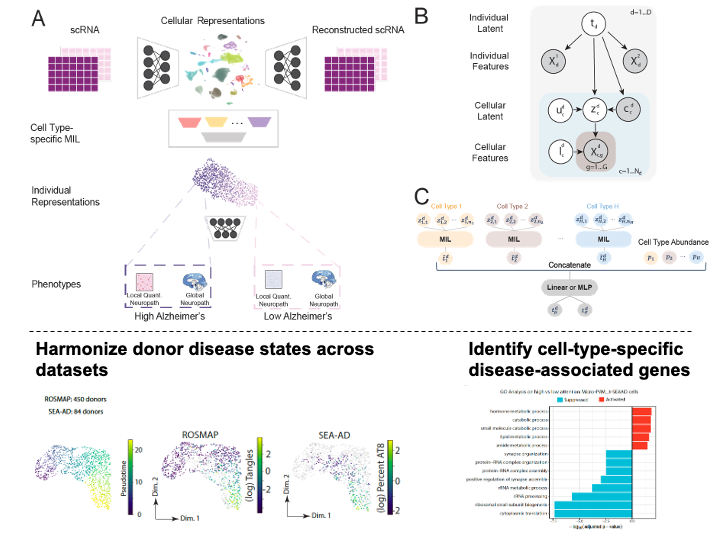
scVIP model diagram: single-cell RNA is encoded into cell representations, pooled by cell-type-specific attention into one representation per donor, and used to predict Alzheimer's disease phenotypes.

scVIP: personalized modeling of single-cell transcriptomes

Allen Institute · Brain Health Accelerator

A generative model that jointly represents gene expression, cell-type composition, and phenotypes in one probabilistic hierarchy, linking single-cell states to individual-level phenotypes across development and disease.

  • Handles partially observed, inconsistently defined phenotypes and batch effects across cohorts
  • Predicts developmental age (r = 0.95), Huntington's disease burden (CCC = 0.90), Alzheimer's staging, and rheumatoid arthritis state
  • Cell-type-aware attention pinpoints the populations behind each phenotype, such as stress-responsive microglia and inflammatory T cells
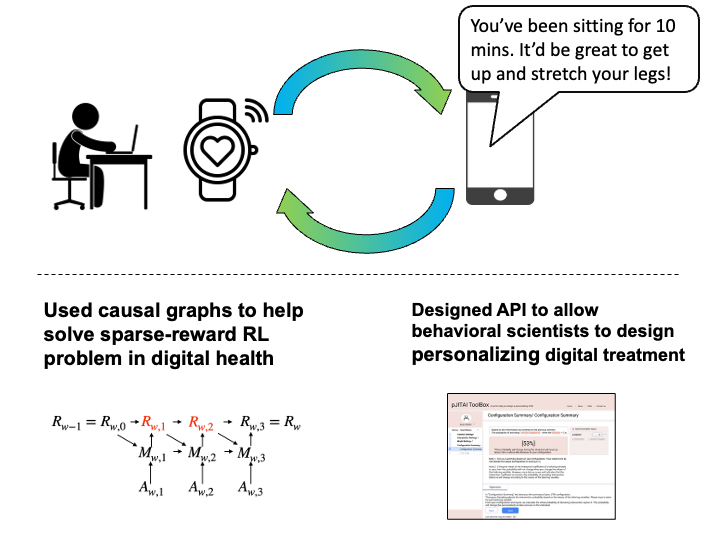
A wearable senses that a person has been sitting and a phone suggests a short walk; below, a causal graph linking daily step counts to a weekly outcome, and a screenshot of the pJITAI toolbox.

Personalizing digital health interventions with reinforcement learning

Harvard Statistics · Statistical Reinforcement Learning Lab · 2021–2024

Reinforcement learning methods for personalized digital health interventions, using graphical models to connect high-frequency behavioral mediators with sparse, delayed health outcomes.

  • Uses causal graphs to learn from sparse, delayed rewards in mobile health
  • Maps Thompson sampling onto study design: actions, proximal outcomes, interpretable priors
  • Toolbox and API that let behavioral scientists design and run these algorithms in studies
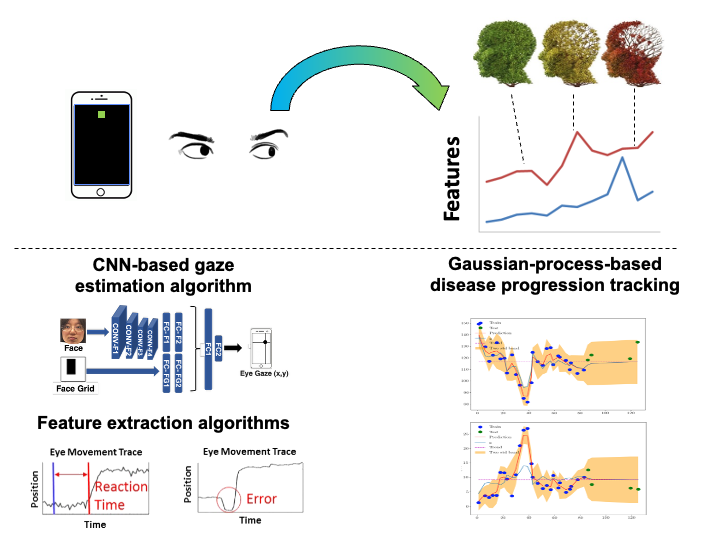
A phone displays an eye-movement task; a CNN estimates gaze from the camera video, reaction time and errors are extracted from the eye trace, and Gaussian process models track each person's features over time.

Tracking neurocognitive state through eye movements on mobile devices

MIT EECS · Ph.D. research · 2016–2021

A mobile platform, computer vision pipeline, and Bayesian models that measure eye movements with a phone or tablet camera to track neurodegenerative disease remotely.

  • App-based tasks collect longitudinal eye-movement data outside the clinic
  • Automated measurement of saccade reaction time and errors from camera video
  • Gaussian process models capture each person's feature trajectory over time